Who Is a Good Candidate for Endoscopic Spine Surgery?
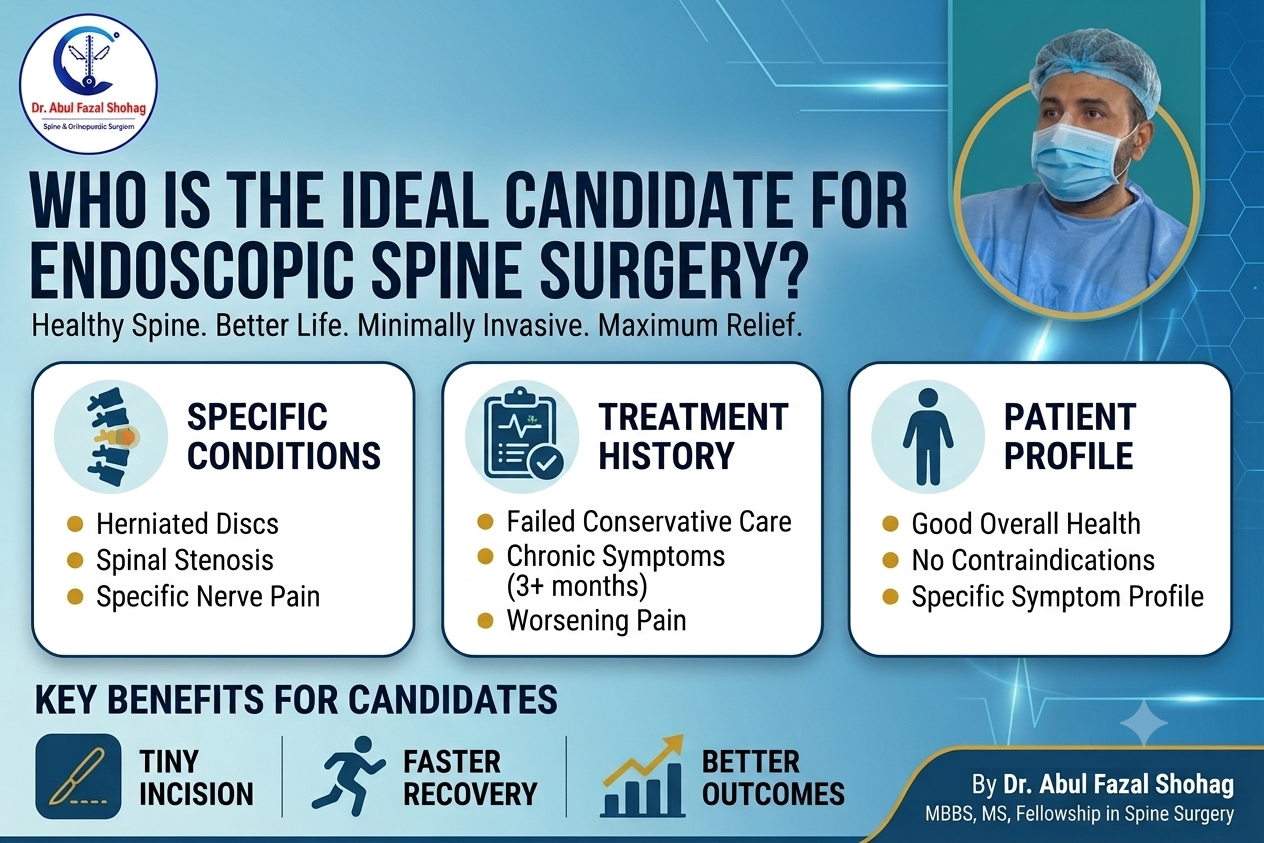
If your back or leg pain has lasted for weeks and nothing seems to help, you've probably come across the term "endoscopic spine surgery" in your search for answers. It sounds appealing — smaller incision, faster recovery — but the question that actually matters is simple: are you someone this procedure can help? Not every spine problem qualifies, and knowing where you stand can save you time, worry, and unnecessary appointments.
What Is Endoscopic Spine Surgery?
Endoscopic spine surgery is a minimally invasive technique used to treat problems like herniated discs, spinal stenosis, and nerve compression. Instead of a large open incision, the surgeon works through a tube less than a centimeter wide, guided by a tiny high-definition camera called an endoscope. This allows precise treatment of the affected area while leaving the surrounding muscles, ligaments, and bone largely undisturbed.
Because the approach is so targeted, it's often described as "keyhole" spine surgery — a small entry point doing the work of a much larger one.
Who Is a Good Candidate for Endoscopic Spine Surgery?
You may be a good candidate if you have one or more of the following:
- Persistent lower back pain that radiates into the buttock, leg, or foot (sciatica)
- Numbness, tingling, or weakness along a nerve pathway in the leg
- An MRI-confirmed herniated or bulging disc that matches your symptoms
- Spinal stenosis causing pain or heaviness in the legs when walking or standing
- Symptoms that have not improved after 6-8 weeks of conservative treatment such as physiotherapy, medication, or rest
- Difficulty performing daily activities — walking, sitting, standing, or sleeping — because of spine-related pain
- Good overall health, without conditions that would make anesthesia or surgery unusually risky
Who May Not Be an Ideal Candidate
Endoscopic techniques aren't right for every spinal condition. You may need a different approach if you have:
- Severe spinal instability or significant deformity (like advanced scoliosis)
- Multiple spinal levels affected at once requiring extensive correction
- Active infection at the surgical site
- Certain tumors or fractures requiring open access
- A spine that has undergone multiple previous surgeries with significant scar tissue
None of this is something you need to work out on your own — a detailed consultation and MRI evaluation are what actually determine candidacy, not guesswork based on symptoms alone.
How the Procedure Works
For patients who are candidates, the procedure generally follows these steps:
1. Positioning and imaging: You lie on the treatment table, and live X-ray guidance locates the exact affected disc or nerve level.
2. Small entry point: A needle and dilator create a path to the target area through a skin opening usually under 1cm.
3. Endoscopic visualization: The endoscope provides a magnified, high-definition view of the disc, nerve, and surrounding tissue in real time.
4. Targeted treatment: Using fine instruments passed through the tube, the surgeon removes the herniated fragment or relieves the nerve compression causing symptoms.
5. Closure: The tube is withdrawn, and the tiny incision is closed with a single stitch or adhesive strip.
Most procedures take 45 minutes to an hour and can be performed under local or regional anesthesia, meaning many patients remain awake or lightly sedated throughout.
Benefits vs. Traditional Open Surgery
- Incision size: Under 1cm compared to 3-5cm with open surgery
- Muscle disruption: Minimal, muscle-splitting approach rather than cutting or retracting muscle
- Blood loss: Negligible compared to moderate blood loss in open procedures
- Hospital stay: Often same-day or overnight versus 2-4 days
- Anesthesia: Local or regional often possible versus general anesthesia typically required
- Recovery speed: Days to return to light activity versus weeks
Because healthy tissue is preserved, patients frequently report less post-operative pain and a quicker return to normal life.
Recovery Timeline
Most patients walk within hours of the procedure and go home the same day or after one night of observation. Light activities and desk work can often resume within a week. Physiotherapy usually begins around weeks 2-4 to rebuild strength and support long-term spine health. By 6-12 weeks, most patients — depending on their job and overall condition — are able to resume more demanding physical activity, always under their surgeon's guidance.
Risks and Limitations
Endoscopic spine surgery is generally very safe, but like any procedure it carries some risk, including recurrent disc herniation at the same level, temporary nerve irritation or numbness, infection (rare given the small incision), or incomplete symptom relief if other factors are contributing to the pain. These risks are discussed in detail during consultation, alongside your specific MRI findings and health history.
Frequently Asked Questions
How do I know if I'm a candidate for endoscopic spine surgery?
The best way to know is through a consultation and MRI evaluation. Your surgeon will assess your symptoms, imaging, and response to conservative treatment to determine if you're a good fit.
Is endoscopic spine surgery only for herniated discs?
No. It's also used to treat spinal stenosis, nerve compression, and certain other spine conditions, depending on the specific diagnosis.
What if conservative treatment hasn't worked for me?
If physiotherapy, medication, or rest hasn't improved your symptoms after 6-8 weeks, that's often when endoscopic surgery becomes a reasonable option to discuss with a spine surgeon.
Can older patients have endoscopic spine surgery?
Age alone doesn't rule someone out. Overall health and the specific spinal condition matter more than age when determining candidacy.
Is endoscopic spine surgery safe for people with other health conditions?
Many patients with controlled health conditions are still candidates, especially since local or regional anesthesia is often possible. Your surgeon will evaluate your specific case.
What happens if I'm not a good candidate for endoscopic surgery?
If endoscopic surgery isn't suitable for your condition, your surgeon will discuss alternative treatment options, whether conservative care or a different surgical approach.
Why Choose Dr Abul Fazal Shohag?
Dr Abul Fazal Shohag is an Orthopaedic and Spine Surgeon holding MBBS, BCS (Health), and MS in Orthopaedic Surgery, along with a Fellowship in Spine Surgery (BSOH). He also serves as an Assistant Professor of Spine Surgery. He specialises in the diagnosis and treatment of spinal disorders, including slipped discs, sciatica, spinal stenosis, and minimally invasive spine procedures. Every patient receives an individualised treatment plan based on clinical findings, imaging, and international evidence-based guidelines.
Conclusion
Determining whether you're a good candidate for endoscopic spine surgery isn't something to figure out alone — it depends on your specific symptoms, MRI findings, and overall health. A detailed consultation is the clearest way to know your options and get a treatment plan built around your condition. Book a consultation to find out if endoscopic spine surgery is right for you.
Chamber: Al-Khalil Hospital and Diagnostic Center, Kumarshil More, Brahmanbaria
Appointment: 01791156413, 01776448669