Who Is the Best Candidate for Endoscopic Spine Surgery?
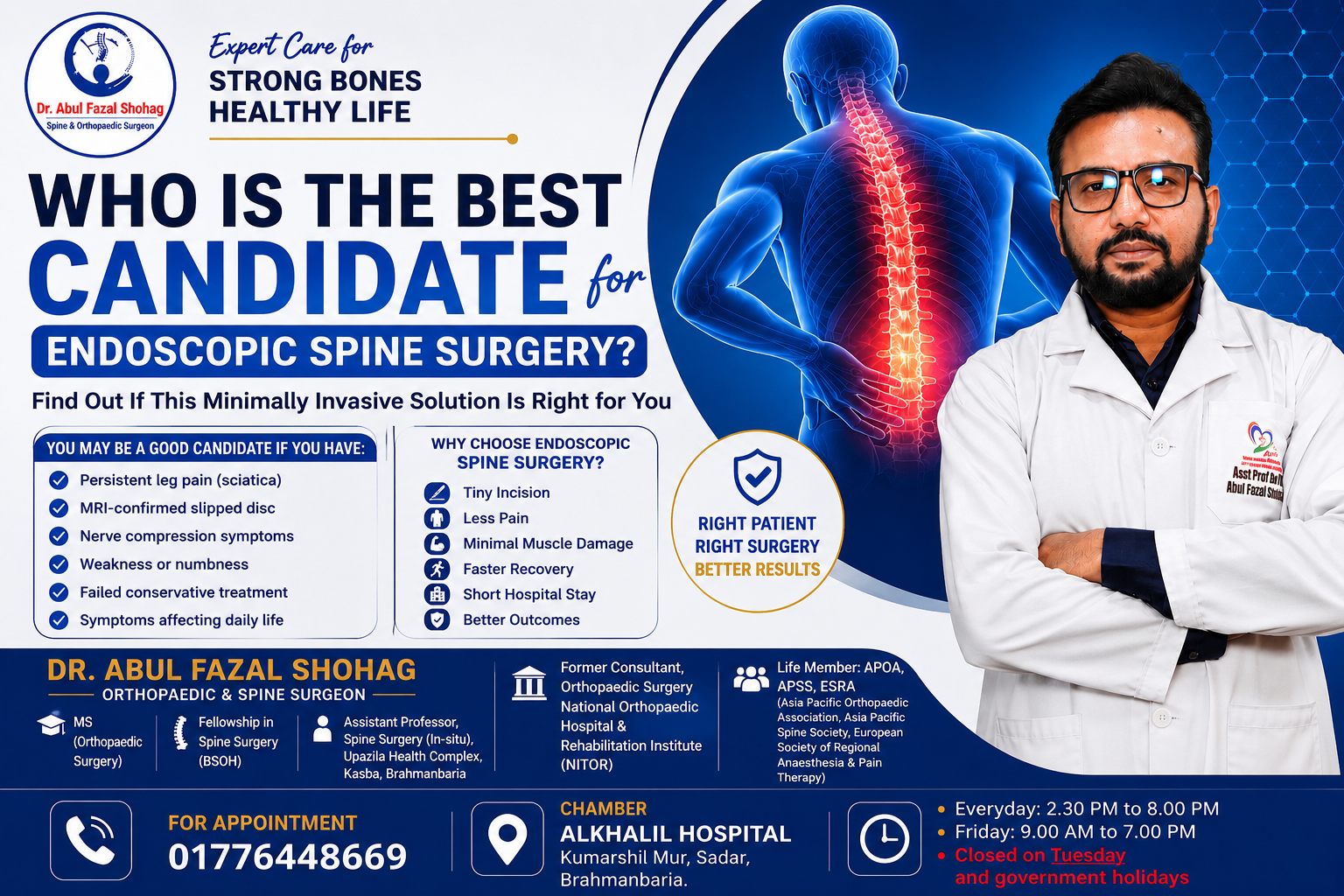
Endoscopic spine surgery has a reputation for being the gentler, faster-recovery option — but not everyone with back or leg pain will get the same result from it. Surgeons look at a specific combination of factors to identify who will benefit most. If you're trying to figure out where you stand, understanding the "best candidate" profile can help you have a much more focused conversation at your next consultation.
What Is Endoscopic Spine Surgery?
Endoscopic spine surgery is a minimally invasive technique used to treat spinal conditions such as herniated discs, sciatica, and spinal stenosis. The surgeon works through an opening smaller than a centimeter, guided by a high-definition camera called an endoscope, allowing precise treatment of the affected disc or nerve while leaving surrounding muscle and bone largely undisturbed.
The Ideal Candidate Profile
While many patients qualify for endoscopic treatment, surgeons generally consider the following combination to represent the best candidates:
- A single, clearly identified disc level causing symptoms, confirmed on MRI
- Symptoms that closely match the imaging findings — the pain pattern lines up with the compressed nerve
- Leg-dominant pain (sciatica) rather than pain confined mostly to the back
- No significant spinal instability or major structural deformity
- Good general health, without conditions that would make anesthesia unusually risky
- Symptoms present for at least 6-8 weeks despite conservative treatment like physiotherapy, medication, or rest
- Realistic expectations about recovery and outcomes, understanding that endoscopic surgery treats a specific problem rather than "curing" the spine broadly
Patients who fit this profile tend to see the fastest recovery and the highest satisfaction with results — though this doesn't mean patients outside this exact profile can't still benefit; it simply means their case may need more individualised evaluation.
Factors That Make Someone a Borderline or Less Ideal Candidate
- Multiple spinal levels affected simultaneously, requiring a broader surgical approach
- Significant spinal instability or advanced deformity such as severe scoliosis
- Extensive scar tissue from previous spine surgeries
- Active infection at the intended surgical site
- Certain tumors or fractures needing open surgical access
Being a "less ideal" candidate doesn't necessarily rule out endoscopic treatment entirely — some complex cases can still be managed endoscopically depending on the surgeon's experience and the specific anatomy involved. This is exactly why imaging and a hands-on consultation matter more than self-assessment based on symptoms alone.
How the Procedure Works
For patients who are confirmed candidates, the procedure generally follows these steps:
1. Positioning and imaging: You lie on the treatment table, and live X-ray guidance locates the exact affected disc or nerve level.
2. Small entry point: A needle and dilator create a path to the target area through a skin opening usually under 1cm.
3. Endoscopic visualization: The endoscope provides a magnified, real-time view of the disc, nerve, and surrounding tissue.
4. Targeted treatment: Fine instruments passed through the tube remove the herniated fragment or relieve the nerve compression causing symptoms.
5. Closure: The tube is withdrawn and the tiny incision is closed with a single stitch or adhesive strip.
Most procedures take 45 minutes to an hour and can often be performed under local or regional anesthesia.
Benefits vs. Traditional Open Surgery
- Incision size: Under 1cm compared to 3-5cm with open surgery
- Muscle disruption: Minimal, muscle-splitting approach rather than cutting or retracting muscle
- Blood loss: Negligible compared to moderate blood loss in open procedures
- Hospital stay: Often same-day or overnight versus 2-4 days
- Recovery speed: Days to return to light activity versus weeks
For patients who match the ideal candidate profile, these benefits are typically most pronounced — a well-matched case tends to have the smoothest, fastest recovery.
Recovery Timeline
Most patients walk within hours of the procedure and go home the same day or after one night of observation. Light activities and desk work can often resume within a week. Physiotherapy usually begins around weeks 2-4, and by 6-12 weeks, most patients can gradually return to more demanding physical activity, depending on their job and how closely they follow their surgeon's guidance.
Risks and Limitations
Endoscopic spine surgery is generally very safe, but as with any procedure, it carries some risk, including recurrent disc herniation at the same level, temporary nerve irritation or numbness, and rare infection given the minimally invasive approach. Outcomes also depend heavily on how closely a patient's case matches the ideal candidate profile — which is why a thorough evaluation is essential before deciding on surgery.
Frequently Asked Questions
What makes someone the "best" candidate rather than just an eligible one?
The best candidates typically have a single, clearly identified disc level, symptoms that closely match their MRI findings, and good general health — this combination tends to produce the fastest, most predictable recovery.
Can I still have endoscopic surgery if I'm not an ideal candidate?
In many cases, yes. Some complex cases can still be managed endoscopically depending on the surgeon's experience and specific anatomy, though outcomes and recovery may vary.
Does age affect whether I'm a good candidate?
Age alone doesn't disqualify someone. Overall health and the specific spinal condition matter far more than age when determining candidacy.
How is candidacy actually confirmed?
Through a detailed consultation combined with MRI evaluation. Imaging confirms the exact source of symptoms and helps determine whether an endoscopic approach is appropriate.
What if my symptoms don't clearly match my MRI findings?
This is exactly the kind of case that needs more individualised evaluation, since a mismatch between symptoms and imaging can affect surgical outcomes and treatment planning.
Is a "less ideal" candidate at higher risk during surgery?
Not necessarily at higher risk, but their case typically requires more careful planning and experienced surgical judgment to achieve the best possible outcome.
Why Choose Dr Abul Fazal Shohag?
Dr Abul Fazal Shohag is an Orthopaedic and Spine Surgeon holding MBBS, BCS (Health), and MS in Orthopaedic Surgery, along with a Fellowship in Spine Surgery (BSOH). He also serves as an Assistant Professor of Spine Surgery. He specialises in the diagnosis and treatment of spinal disorders, including slipped discs, sciatica, spinal stenosis, and minimally invasive spine procedures. Every patient receives an individualised treatment plan based on clinical findings, imaging, and international evidence-based guidelines.
Conclusion
Being the "best" candidate for endoscopic spine surgery comes down to a specific combination of symptoms, imaging findings, and overall health — not something you can determine from a checklist alone. A detailed consultation and MRI evaluation are the clearest way to understand exactly where you stand and what treatment path makes sense for your condition. Book a consultation to get a personalised assessment.
Chamber: Al-Khalil Hospital and Diagnostic Center, Kumarshil More, Brahmanbaria
Appointment: 01791156413, 01776448669