Is Endoscopic Spine Surgery Safe? Benefits, Risks & Success Rate Explained
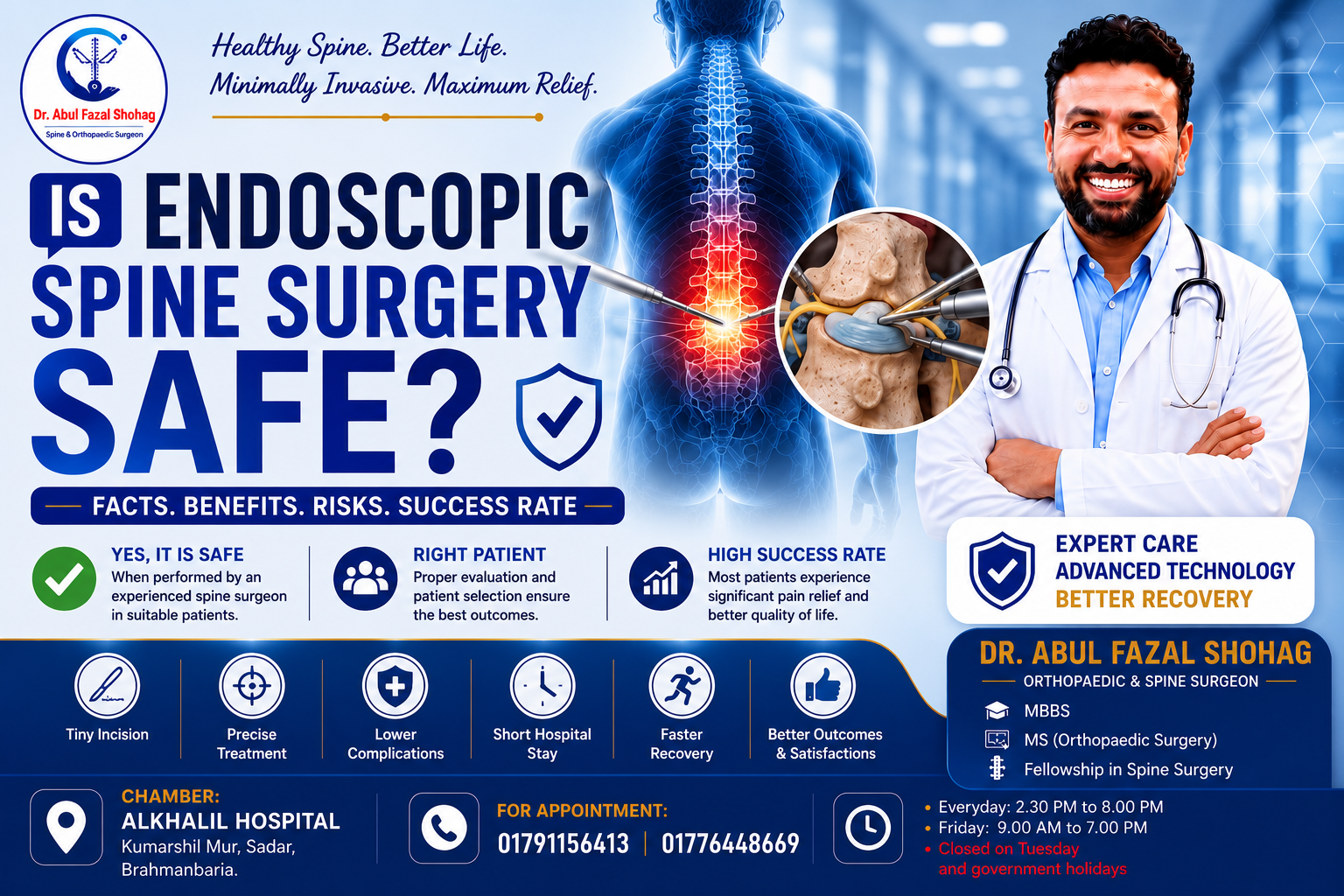
# Is Endoscopic Spine Surgery Safe? Benefits, Risks & Success Rate Explained
One of the first questions patients ask after being advised to undergo Endoscopic Spine Surgery is, "Is it safe?"
This concern is completely understandable. The spine contains delicate nerves that control movement and sensation, so many people naturally worry about the risks of surgery. Fortunately, advances in medical technology have made spine surgery safer than ever before. Endoscopic Spine Surgery is one of the most advanced minimally invasive techniques available today, offering excellent outcomes for carefully selected patients.
When performed by an experienced spine surgeon using proper patient selection and modern equipment, Endoscopic Spine Surgery has a high success rate with a low risk of complications.
## What Is Endoscopic Spine Surgery?
Endoscopic Spine Surgery is a minimally invasive procedure performed using a high-definition camera called an endoscope and specialised surgical instruments. The surgery is carried out through a tiny skin incision, usually less than one centimetre long.
The endoscope allows the surgeon to see the compressed nerve clearly on a monitor and remove the herniated disc or other tissue causing nerve compression without extensive muscle damage.
## Is Endoscopic Spine Surgery Really Safe?
Yes.
Numerous studies have shown that Endoscopic Spine Surgery is a safe and effective treatment for carefully selected patients with conditions such as:
• Lumbar Disc Prolapse (PLID)
• Sciatica
• Lumbar Spinal Stenosis
• Foraminal Stenosis
• Selected Cervical Disc Herniation
Because the procedure causes less muscle injury and less blood loss than traditional open surgery, many patients recover faster with fewer complications.
However, like every surgical procedure, no operation is completely risk-free. A detailed consultation and MRI assessment are essential before deciding whether this surgery is appropriate for you.
## Why Is Endoscopic Spine Surgery Considered Safer?
Several factors contribute to its safety.
### Tiny Skin Incision
The incision is usually less than one centimetre, reducing tissue trauma and improving cosmetic results.
### Minimal Muscle Damage
Unlike traditional open surgery, healthy muscles are preserved as much as possible.
### Better Visualisation
The high-definition camera provides a magnified view of the spinal structures, allowing precise removal of the tissue compressing the nerve.
### Less Blood Loss
Smaller incisions and minimal tissue disruption usually result in very little blood loss.
### Lower Infection Risk
Because the wound is much smaller, the chance of wound infection is generally reduced.
### Faster Recovery
Most patients begin walking within a few hours and return home the same day or the following day.
## Benefits of Endoscopic Spine Surgery
Patients often choose Endoscopic Spine Surgery because of its many advantages.
These include:
• Tiny incision
• Less postoperative pain
• Minimal muscle injury
• Less blood loss
• Lower infection risk
• Faster recovery
• Short hospital stay
• Earlier return to work
• Smaller scar
• Better patient satisfaction
## Are There Any Risks?
Although complications are uncommon, every surgical procedure has potential risks.
Possible complications include:
• Infection
• Bleeding
• Dural tear (tear in the covering of the spinal cord)
• Temporary numbness
• Nerve injury
• Persistent pain
• Recurrent disc prolapse
• Need for further surgery in selected cases
Fortunately, these complications are relatively uncommon when surgery is performed by an experienced spine surgeon.
## What Is the Success Rate?
The success rate depends on:
• Correct diagnosis
• Proper patient selection
• Surgical experience
• Patient compliance with rehabilitation
For patients with a slipped disc causing sciatica, Endoscopic Spine Surgery has an excellent success rate, with most patients experiencing significant improvement in leg pain and quality of life.
## Who Is a Good Candidate?
You may be suitable if you have:
• Persistent sciatica
• MRI-confirmed slipped disc
• Failure of medication and physiotherapy
• Progressive muscle weakness
• Difficulty walking due to nerve compression
• Symptoms affecting your daily activities
Not every patient with back pain requires surgery. A detailed examination is essential before making a decision.
## How Can You Reduce Surgical Risks?
Patients also play an important role in achieving successful outcomes.
Before surgery:
• Stop smoking
• Control diabetes
• Inform your surgeon about all medications
• Follow preoperative instructions carefully
After surgery:
• Walk regularly
• Attend physiotherapy if advised
• Avoid heavy lifting
• Maintain good posture
• Perform strengthening exercises
• Maintain a healthy body weight
Following your surgeon's instructions significantly improves recovery and reduces the chance of recurrence.
## Why Choose Dr Abul Fazal Shohag?
Dr Abul Fazal Shohag is an Orthopaedic and Spine Surgeon with Fellowship training in Spine Surgery. He specialises in the treatment of slipped discs, sciatica, spinal stenosis, and other spinal disorders using evidence-based techniques. His goal is to provide personalised care and recommend the most appropriate treatment, including minimally invasive and endoscopic spine surgery when indicated.
## Conclusion
Endoscopic Spine Surgery has revolutionised modern spine care by providing a safe, minimally invasive option for many patients with nerve compression and slipped discs. It offers smaller incisions, less pain, faster recovery, and excellent outcomes when performed for the right indications.
If you have persistent leg pain, numbness, or weakness despite conservative treatment, consult a qualified spine surgeon. A proper clinical assessment and MRI scan will help determine whether Endoscopic Spine Surgery is the safest and most effective treatment for your condition.
## Frequently Asked Questions
### Q1. Is Endoscopic Spine Surgery safer than open surgery?
For appropriately selected patients, Endoscopic Spine Surgery generally causes less muscle damage, less blood loss, less postoperative pain, and a faster recovery than traditional open spine surgery.
### Q2. How long does Endoscopic Spine Surgery take?
Most procedures take between 45 and 90 minutes, depending on the complexity of the condition.
### Q3. Will I need to stay in hospital?
Many patients are discharged on the same day or the following day after surgery.
### Q4. Can elderly patients undergo Endoscopic Spine Surgery?
Yes. Many older adults benefit from this minimally invasive procedure, provided they are suitable candidates after a thorough medical evaluation.
### Q5. Can Endoscopic Spine Surgery permanently cure sciatica?
If sciatica is caused by a slipped disc or another condition that can be successfully treated with surgery, many patients experience long-lasting relief. Maintaining a healthy lifestyle and following postoperative advice helps reduce the risk of recurrence.