Endoscopic Spine Surgery vs Open Spine Surgery: Which Is Better?
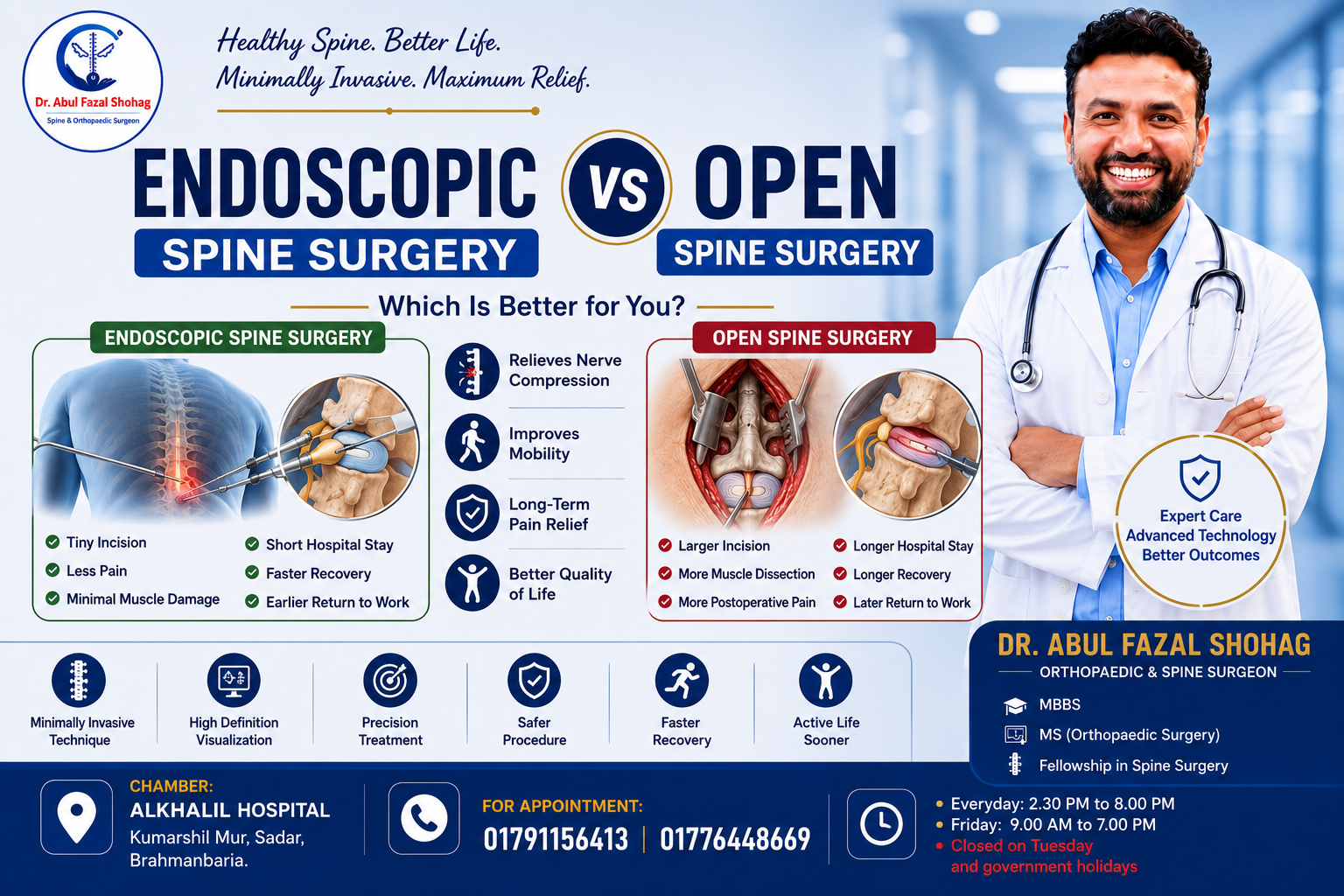
# Endoscopic Spine Surgery vs Open Spine Surgery: Which Is Better?
If you have been advised to undergo spine surgery, one of the first questions that comes to mind is whether you should choose Endoscopic Spine Surgery or traditional Open Spine Surgery.
Many patients worry about large cuts, severe pain, long hospital stays, and months of recovery. Fortunately, advances in spine surgery have made it possible to treat many spinal conditions through minimally invasive techniques, including Endoscopic Spine Surgery.
However, not every patient is suitable for endoscopic surgery. Understanding the differences between these two approaches will help you make an informed decision together with your spine surgeon.
## What Is Endoscopic Spine Surgery?
Endoscopic Spine Surgery is an advanced minimally invasive technique performed using a high-definition camera (endoscope) and specialised surgical instruments inserted through a tiny skin incision, usually less than one centimetre.
The surgeon can clearly visualise the compressed nerve and remove the disc fragment or other structures causing pain while preserving normal muscles and surrounding tissues.
## What Is Open Spine Surgery?
Open Spine Surgery is the conventional method of treating spinal disorders. It requires a larger incision to expose the spine directly.
Although open surgery remains the best option for some complex spinal conditions, it usually involves more muscle dissection and a longer recovery period.
## Conditions That Can Be Treated with Endoscopic Spine Surgery
Endoscopic Spine Surgery is commonly used for:
• Lumbar disc prolapse (PLID)
• Sciatica
• Lumbar spinal stenosis
• Foraminal stenosis
• Selected recurrent disc prolapse
• Certain cervical disc problems
Patient selection is extremely important for achieving the best results.
## Conditions That May Require Open Spine Surgery
Traditional open surgery may be necessary for:
• Severe spinal deformity
• Complex scoliosis
• Multiple-level spinal instability
• Large spinal tumours
• Major spinal trauma
• Extensive spinal infections
• Some revision spine surgeries
## Endoscopic Spine Surgery vs Open Spine Surgery
### Skin Incision
Endoscopic Spine Surgery requires a tiny incision, usually less than one centimetre.
Open Spine Surgery requires a much larger incision.
### Muscle Damage
Endoscopic surgery preserves most of the normal muscles.
Open surgery usually requires greater muscle dissection.
### Blood Loss
Blood loss is usually minimal during endoscopic surgery.
Open surgery generally causes more blood loss.
### Postoperative Pain
Most patients experience less pain after endoscopic surgery.
Open surgery is often associated with more postoperative discomfort.
### Hospital Stay
Many patients undergoing endoscopic surgery return home on the same day or the next day.
Open surgery usually requires a longer hospital stay.
### Recovery Time
Recovery after endoscopic surgery is generally much faster.
Patients undergoing open surgery often need several weeks or months before returning to normal activities.
### Cosmetic Result
The tiny incision used in endoscopic surgery leaves a very small scar.
Open surgery usually results in a larger visible scar.
## Is Endoscopic Spine Surgery Always Better?
Not necessarily.
Endoscopic Spine Surgery offers many advantages, but it is not the right choice for every patient.
The best procedure depends on:
• Your diagnosis
• MRI findings
• Severity of nerve compression
• Number of spinal levels involved
• Presence of spinal instability
• Overall health
The most appropriate treatment should always be decided after a detailed clinical examination and review of imaging studies.
## Advantages of Endoscopic Spine Surgery
• Tiny incision
• Minimal muscle injury
• Less blood loss
• Reduced postoperative pain
• Lower infection risk
• Faster recovery
• Earlier return to work
• Shorter hospital stay
• Better cosmetic appearance
## Are There Any Risks?
Every surgical procedure has potential risks.
Possible complications include:
• Infection
• Bleeding
• Dural tear
• Nerve injury
• Persistent symptoms
• Recurrent disc prolapse
Fortunately, serious complications are uncommon when surgery is performed by an experienced spine surgeon.
## Recovery After Endoscopic Spine Surgery
Most patients experience rapid improvement.
Recovery usually includes:
• Walking within a few hours
• Going home the same day or the following day
• Returning to desk work within two to four weeks
• Gradually resuming normal exercise
Following your surgeon's rehabilitation programme is essential for achieving the best long-term outcome.
## How Can You Improve Surgical Success?
Patients can improve their recovery by:
• Maintaining a healthy body weight
• Quitting smoking
• Performing prescribed physiotherapy
• Strengthening core muscles
• Following lifting precautions
• Maintaining good posture
• Remaining physically active
## Why Choose Dr Abul Fazal Shohag?
Dr Abul Fazal Shohag is an Orthopaedic and Spine Surgeon with Fellowship training in Spine Surgery. He specialises in the management of slipped discs, spinal stenosis, sciatica, and other spinal disorders. He offers evidence-based treatment plans and performs modern minimally invasive spine procedures, including Endoscopic Spine Surgery, for appropriately selected patients.
## Conclusion
Both Endoscopic Spine Surgery and Open Spine Surgery have important roles in modern spine care. Endoscopic surgery provides excellent outcomes for carefully selected patients with smaller incisions, less pain, and quicker recovery. However, some complex spinal conditions still require conventional open surgery.
If you are experiencing persistent back pain, sciatica, or symptoms of nerve compression, consult an experienced spine surgeon. A thorough assessment and MRI evaluation will help determine the safest and most effective treatment for your condition.
## Frequently Asked Questions
Q1. Is Endoscopic Spine Surgery safer than Open Spine Surgery?
Both procedures are safe when performed by an experienced spine surgeon. Endoscopic surgery generally causes less tissue damage and allows faster recovery in suitable patients.
Q2. Will I have a large scar after Endoscopic Spine Surgery?
No. The incision is usually less than one centimetre, resulting in a very small scar.
Q3. How soon can I walk after Endoscopic Spine Surgery?
Most patients are encouraged to walk within a few hours after surgery.
Q4. Can every slipped disc be treated with Endoscopic Spine Surgery?
No. Treatment depends on the location and severity of the disc prolapse. Your spine surgeon will determine whether you are a suitable candidate.
Q5. Which surgery has a faster recovery?
Endoscopic Spine Surgery generally offers a shorter hospital stay, less pain, and a faster return to daily activities compared with traditional open spine surgery.